
Slip-In vs Chassis-Mounted Service Bodies: Which One Fits Your Operation?
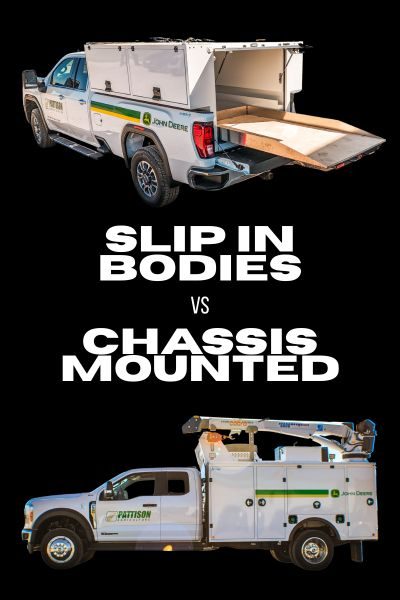
When it comes to service truck setups, there’s no one-size-fits-all answer. The right body depends on how you use the truck, what equipment you need to carry, and how much of your operation depends on that truck every day.
For some operations, a slip-in service body is the smarter fit. For others, a chassis-mounted service body is the clear choice.
Both have their place — they’re just built for different kinds of work.
Slip-In Service Bodies: Flexible, Transferable, and Easy to Live With
A slip-in service body is a great fit for operations that need organized storage and work space, but don’t necessarily need a crane, a big compressor, or a full mechanic-truck setup.
One of the biggest advantages of a slip-in is transferability.
Built to Outlast the Truck
With both aluminum slip-in bodies and Maranda fiberglass slip-ins, the body can often outlast the truck it’s riding in. When it’s time to replace the pickup, the service body can be moved into the next truck instead of starting over with a whole new setup.
That’s a big advantage for fleets.
A good example is a customer like Pattison Ag. If a pickup needs to be replaced, the body doesn’t have to be retired with it. The slip-in can be swapped into a newer truck and put right back to work. Instead of reinvesting in another full body package, the original service body keeps going.
A Good Fit for Fleets
For fleet customers, that flexibility matters.
A lot of aluminum slip-in bodies are built around common box sizes, making them a fairly universal fit across trucks. If you have a body built for an 8′ box, it can move from one long-box truck to another. Same idea with 6′ or 6’6″ boxes on short-box trucks.
That makes it easier to:
- replace trucks without replacing the body
- keep service setups consistent across the fleet
- get more life out of the original investment
- reduce downtime when a truck needs to be swapped out
The same thinking applies to Maranda fiberglass slip-ins. They’re lightweight, durable, and built to last well beyond a single truck lifecycle. If the pickup changes, the body can go with it.
Great for Smaller Operations
Slip-ins also make a lot of sense for smaller operations that want a service setup without moving into a larger chassis-mounted truck.
Because they fit inside a pickup box, they’re often easier to drive, easier to park, and easier to keep around day to day. For maintenance work, service calls, municipal use, telecom, or fiber optic work, that can be a big advantage. A truck that fits in a regular driveway or a tighter urban jobsite is sometimes far more useful than a larger dedicated service truck.
They’re also a smart option when you don’t need a crane.
If the job is more about carrying tools, parts, fittings, test equipment, or service supplies — and less about lifting heavy components — a slip-in can give you a lot of functionality without stepping up to a bigger truck.
Don’t Underestimate What a Slip-In Can Hold
Slip-ins may be smaller than a full chassis-mounted service body, but they can still pack a lot in.
Shelving, storage compartments, side access, and slide-out cargo trays can turn a pickup into a very capable service unit. If the goal is to keep tools organized, stay protected from the weather, and have everything in one place without needing a full mechanic truck, a slip-in can be a very practical solution.
Chassis-Mounted Service Bodies: Built for the Bigger Jobs
If slip-ins are about flexibility, chassis-mounted service bodies are about building the truck around the job.
These are the trucks for the big machinery guys, heavy field service operations, and technicians whose truck truly is their workshop. If the truck needs to carry a crane, welder, compressor, generator, waste oil system, drawer package, lighting, and a full load of tools every day, this is where a chassis-mounted body makes sense.
This is where something like the 11 Series aluminum service body comes in.
When the Truck Is the Shop
A chassis-mounted service truck is designed for operations where the truck isn’t just getting you to the job — it’s the main service platform once you get there.
These are the builds for customers who need to:
- service large equipment in the field
- lift heavy parts with a crane
- carry air, power, welding, and fluid systems onboard
- bring a full tool inventory to the jobsite
- work long days away from the shop
For these operations, the truck is a major investment because it’s expected to do much more than transport tools. It has to function like a mobile workshop.
More Capacity, More Options, More Capability
That’s the biggest difference with a chassis-mounted service body: it opens the door to a much larger, more specialized build.
Compared to a slip-in, a chassis-mounted setup gives you room for things like:
- cranes
- waste oil systems
- compressors and generators
- drawer and shelving packages
- cabinet heaters
- larger air systems
- heavier service tooling
- custom layouts built around the way the truck will actually be used
For customers working on larger machinery, working in the field every day, or needing one truck to do everything, that extra capacity is worth it.
So Which One Fits Your Operation?
A slip-in service body is likely the better fit if:
- you want a body that can transfer from truck to truck
- you run a fleet of pickups and want flexibility when trucks get replaced
- you don’t need a crane or a full heavy mechanic setup
- you want a service body that’s easy to drive, park, and maintain
- your work is more about tools, parts, storage, and service access than heavy lifting
- you want to get more life out of the body than the truck itself
A chassis-mounted service body is likely the better fit if:
- your truck is a dedicated field service unit
- you need a crane, compressor, welder, generator, or waste oil system
- your technicians work on heavy equipment or larger machinery
- you need maximum storage, payload, and upfit options
- the truck is expected to function as a full mobile workshop