
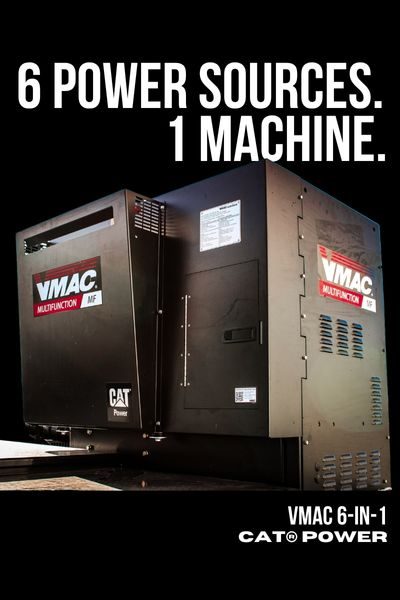
Field service operations require compressed air, electrical generation, welding capability, battery support, and hydraulic power. Traditionally, meeting these requirements means installing multiple separate systems that consume deck space and add complexity. The VMAC 6-in-1 multifunction system consolidates these capabilities into a single Cat-powered unit.
The system combines a 45 CFM rotary screw air compressor, 8 kW AC generator, 250-amp DC welder with adjustable output, 300-amp maximum booster at 13 volts, 100-amp maximum battery charger supporting both 12V and 24V systems, and a 2,800 RPM PTO port for hydraulic pump integration.
Each function operates independently or simultaneously depending on operational requirements. The air compressor delivers continuous flow for pneumatic tools while the generator powers work lights and auxiliary equipment. The welder handles fabrication tasks, the booster provides emergency starting capability, and the battery charger maintains fleet equipment.
The 45 CFM rotary screw compressor provides continuous airflow without the cycling behavior typical of reciprocating designs. This constant delivery maintains consistent tool performance rather than the speed variation that occurs as receiver tank pressure drops between compressor cycles.
The rotary screw design operates at 100% duty cycle, eliminating mandatory rest periods required by reciprocating compressors during extended use. Field operations often involve sustained air tool usage that would exceed the duty cycle limits of reciprocating equipment.
The 8 kW generator output handles multiple power tools, work lighting, and electronic equipment simultaneously. The power quality suits sensitive diagnostic equipment and control systems rather than requiring separate clean power sources.
Grid power availability varies across field service locations. Self-contained generation eliminates dependency on site electrical infrastructure that may not exist or may provide inadequate capacity for professional equipment loads.
The 250-amp DC welder with adjustable output covers stick, TIG, and wire-feed welding processes typical of field repair and fabrication work. The adjustable amperage accommodates different material thicknesses and welding techniques without requiring multiple welders.
The 300-amp booster and 100-amp charger address battery failures that create delays at remote locations. Dead batteries on service trucks or customer equipment generate downtime that compounds when operating away from shop facilities. The integrated battery support eliminates waiting for separate service calls.
The dual-voltage capability (12V/24V) accommodates both light-duty and heavy-duty equipment common in mixed fleets. One system handles battery requirements across different vehicle and equipment types.
The factory-installed cold climate kit maintains operation to negative 40 degrees Fahrenheit. This temperature rating matters for Canadian operations where winter service calls occur regardless of ambient conditions.
Standard equipment often fails to start or operate properly in extreme cold, forcing crews to delay work or use auxiliary heating systems. The integrated cold climate package ensures availability when weather creates the highest demand for emergency repair services.
At 710 pounds, the consolidated system weighs less than the combined weight of separate units providing equivalent functionality. The compact footprint occupies less deck space than installing individual air compressors, generators, welders, and battery chargers.
Deck space represents premium real estate on service trucks. Every square foot consumed by power equipment reduces available space for tool storage, parts inventory, and specialized equipment. The consolidation approach maximizes functional capability per square foot of deck space occupied.
The 2,800 RPM PTO port allows adding a hydraulic pump to the system. This enables powering hydraulic tools and equipment from the same engine that drives the other functions. Operations requiring both pneumatic and hydraulic tools benefit from this dual capability without installing separate hydraulic power units.
The PTO integration matters particularly for crews that need occasional hydraulic capability without justifying a dedicated hydraulic system. The optional addition provides flexibility for varied job requirements.
Single-engine operation means one maintenance schedule rather than tracking service intervals for multiple power units. Oil changes, filter replacements, and routine inspections occur on one engine instead of three or four separate units.
The maintenance consolidation reduces both direct service costs and the administrative overhead of tracking maintenance schedules across multiple power systems. Fleet operations particularly benefit from simplified maintenance management.
For operations with different capability requirements, comparing multifunction systems helps match equipment to specific needs. The complete multifunction power systems category includes options from different manufacturers with varied capacity combinations. Browse service trucks with integrated multifunction systems to see complete upfitting configurations.